


Industry challenge
High-Altitude Pseudo-Satellites (HAPS) are unmanned airships, planes or balloons flying in the stratosphere, operating like satellites but closer to the earth. They are powered exclusively by solar energy and are able to continuously fly for months. Solar panels integrated onto the wings and body directly power the aircraft engines and instrumentation, while secondary batteries charged in daylight power the flight during the night.
Airbus Defence and Space wanted to investigate the performance and stability of Perovskite Solar Cells (PSCs) in a simulated stratospheric environment to see if it would be a solution for high-altitude pseudo-satellites and target applications.
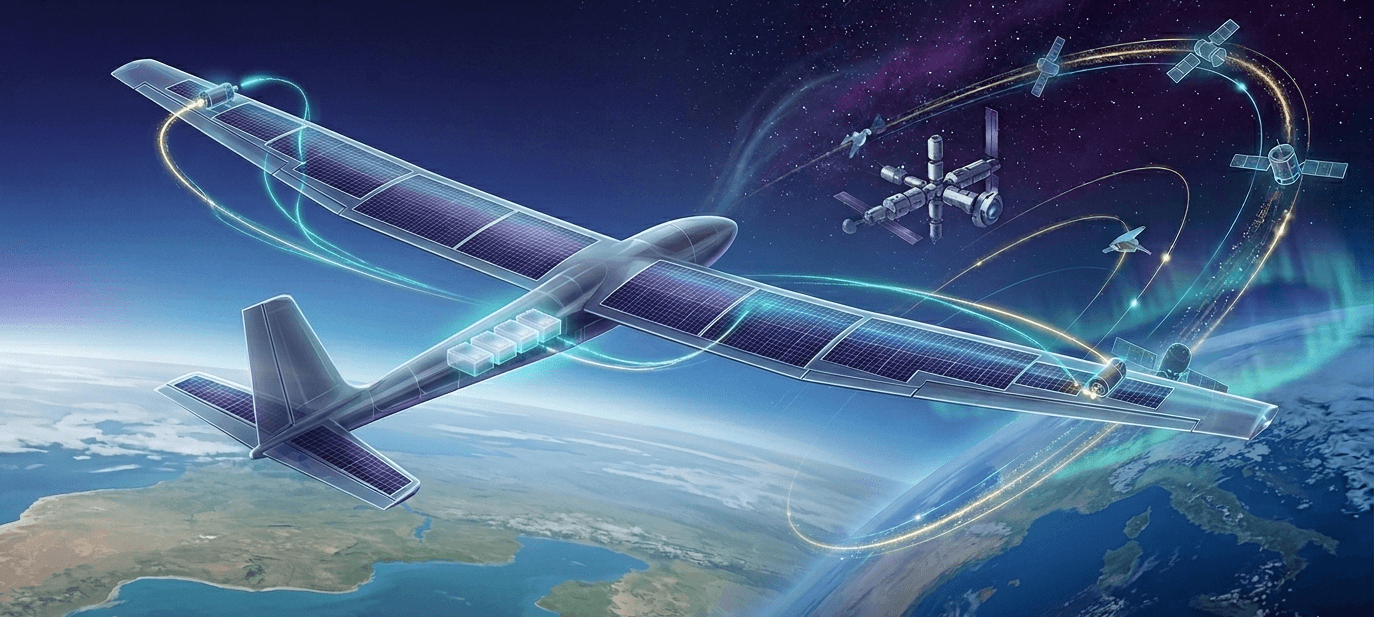
One key advantage of PSCs is that they can be fully printed at low cost and low temperature on light-weight flexible substrates, such as plastic, and they can deliver much higher power-per-weight compared to current state-of-the-art space solar cells.
This makes the PSCs attractive for use in aerospace applications such as search and rescue missions, disaster relief, environmental monitoring and agriculture.
Industry and Academic Collaboration
Following a successful application to Airbus Endeavr, researchers at Swansea University’s College of Engineering were commissioned to investigate the performance and stability of PSCs in non-standard atmospheric conditions.
The research aimed to:
-
understand the effect of large temperature variations, low pressure and a higher level of UV light on the efficiency and stability of the solar cell.
-
develop flexible perovskite cells with a higher power-per-weight than conventional space solar cells.
Key Results
The research found that:
- The power conversion efficiency, known as PCE, is optimised at low temperature
- A maximum efficiency of 18.2 percent under extra-terrestrial illumination – known as AM0 solar spectrum – was reached at -20°C, which is typical of the stratosphere during the daytime.
- Perovskite solar cells, known as PSCs, retain a high AM0 PCE of 17.2 percent at -50°C.
- This low temperature of -50°C can be found in the tropopause – the boundary between the troposphere and the stratosphere – or during the early or last hours of the day in the stratosphere. This means that PSCs can generate power for a longer time during the day and mitigate the use of batteries.
- PSCs can also withstand temperature cycles between +20°C and -85°C in the dark without any loss in performance. This means that these solar cells do not degrade because of because of variations in temperature between day and night.
- PSCs are stable for more than 25 days and retain approximately 80 percent of their initial power conversion efficiency (PCE) under LEDs illumination.
In addition, the research team were able to successfully manufacture flexible perovskite solar cells with a high efficiency of 17 percent* – one of the highest efficiencies demonstrated (to date) for flexible perovskite cells.
* Note: This figure corresponds to a high specific power of 0.6 W/g.
The research results are encouraging:
Claus Zimmermann, Senior Expert Photovoltaic Power Systems at Airbus Defence and Space said:
“This is an exciting project for Airbus, with the Airbus Endeavr funded research and technology project demonstrating that a flexible perovskite solar cell can be manufactured with a high energy efficiency.”
Wolfgang Pecher, Technology Domain Manager at Airbus Defence and Space added:
“With a growing demand from potential customers and their end-users to use HAPS to extend their internet services and data activities, we’ve been encouraged by the results.”
Next Steps
Nick Crew, Research and Technology Manager at Airbus and Chief Operations Officer for Airbus Endeavr Wales, concluded:
“This innovative proof-of-concept project is the first step towards developing a perovskite solar cell solution for high-altitude pseudo-satellites and target applications.
We’re looking forward to working with our industry and academic partners to identify follow-on funding – from Airbus or other interested parties – to develop the initial research idea into an innovative and commercially viable product that can be delivered at industrial scale.”